
















Membrane Proteome Array™
Specificity testing service for antibodies, CAR T cells, and other biotherapeutics
The only platform that maintains each protein’s native structure throughout the entire screening process
7,000+ human proteins
Native binding in unfixed cells
IND-ready report in 4 weeks
100+ successful IND submissions
Read Specificity Insights, our editorial series on antibody specificity testing and our FDA qualification journey.
Antibody Specificity Testing is Critical for Biotherapeutic Safety
Monoclonal antibodies can be targeted, effective treatments with reduced side effects. Yet 1 in 3 antibody-based lead candidates demonstrate off-target binding, also known as antibody cross-reactivity (Norden et al., 2024).
Off-target binding is the largest cause of drug failure in preclinical and early-stage clinical trials. To improve patient safety, specificity testing is essential for all antibody-based biotherapeutics.
Get the Highest Quality Specificity Testing Data with the Membrane Proteome Array
The Membrane Proteome Array (MPA) can identify proteins that have off-target interactions with your molecule early in drug development to significantly de-risk your program. This unique cell-based protein array delivers preclinical safety data for targeted biotherapeutics, including antibodies, CAR-T cell therapies, antibody-drug conjugates (ADCs), and others. Screening on our Secreted Proteome Library (SPL) is available as an optional add-on. Together, the MPA and SPL provide specificity data on 7,000+ human proteins, the largest library available.
The MPA’s speed and price point make it ideal for lead selection. And our ISO-9001 qualified MPA+IND service includes the necessary rigor and support for regulatory filings.
As a company that values quality and customer service, we strive to exceed your expectations.
The MPA has already been used in >100 IND filings, and it’s approaching full FDA qualification as a Drug Development Tool (DDT). To learn more, visit Using MPA Specificity Testing for Regulatory Success.
"Unlike competing technologies, the MPA is an exclusively flow cytometry based method that precludes artifacts caused by fixation and tunes signal-to-noise by testing multiple transfectable cell-types. These thoughtful features make the platform our preferred choice for assessing lead candidate molecules in our pipeline for off-target binding."
—Garrett Gross, PhD, Associate Director of Protein Engineering, Sutro Biopharma
Features: What Sets the MPA Apart
The MPA screens molecules for binding against 6,000 proteins, representing 94% of all human membrane proteins, including nearly all GPCRs, ion channels, and transporters. The full library is expressed in whole, unfixed cells. This means that the proteins your antibody sees in the MPA look like those it would see in vivo.
BIOLOGICALLY RELEVANT — The only platform that uses whole, unfixed cells in all screening and validation steps. Native conformation proteins yield the most physiologically relevant binding data.
QUANTITATIVE — High sensitivity flow cytometry provides quantitative measurements for statistical analysis
COMPATIBLE— Works with all biotherapeutic modalities, including MAbs, scFv, VHH, bispecifics, peptides, ADC, and CAR-T cell therapies
TRUSTED — Over 2,000 antibodies screened from hundreds of customers, with data accepted by the FDA, EMA, NMPA, and other regulatory agencies, including >100 IND filings
Project Workflow
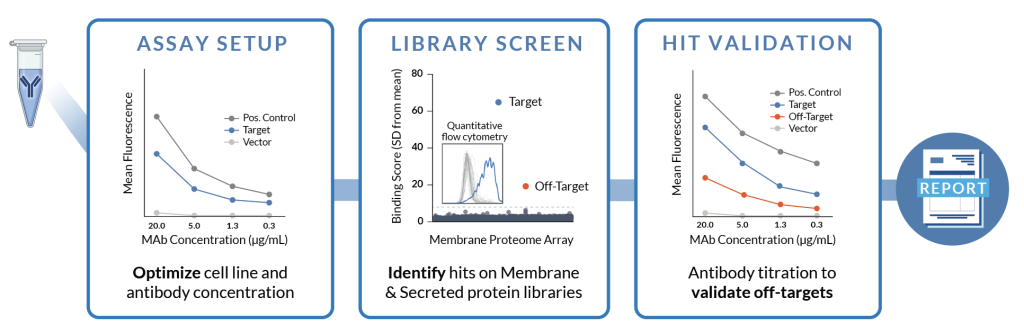
For comprehensive screening on our Membrane and Secreted Proteome libraries, we need about a milligram of your antibody. We’ll then do everything needed for assay setup and screening on all 7,000+ human proteins. Every hit from your screen goes through a validation step, using a dose-response titration experiment, to yield high-confidence binding results. Hit validation is included with every project. Your deliverable is a Study Report with publication-quality data and figures.
To measure binding, the MPA uses high sensitivity flow cytometry on unfixed cells—for both library screening and hit validation. Flow cytometry provides quantitative measurements for statistical analysis, unlike older technologies that provide only subjective scores.
“MPA-based specificity screens are a critical part of our binder selection process. We have been using Integral Molecular for several years and can attest that their professionalism and quality of service are unparalleled. Their team is extremely knowledgeable, reliable, and helpful in identifying potential off-target binding liabilities and performing risk assessment studies.”
—Director of Preclinical Pharmacology and Toxicology at a large commercial-stage biotech company
More Applications & Services:
Antibody off-target testing on soluble proteins for comprehensive safety & pharmacokinetics data
A New Approach Methodology (NAM) for human-relevant specificity data
Identify the target of your antibody or recombinant protein
Featured Case Studies
Publications Featuring the Membrane Proteome Array
For more featured publications and case studies, plus links to webinars, visit the Resources page.
The MPA processes for molecule screening, analysis, and reporting are ISO 9001 certified. To see our certificate and a full description of our commitment to quality, please visit our Quality page.
MPA services are available directly through Integral Molecular or through our distributors
Contact Us to Get a Quote and Start a Project
“We have been very pleased with the data that we obtained from the Membrane Proteome Array platform. This showed that our antibodies recognize only their select target, and not other membrane proteins in their panel.”
—Maria Gonzalez-Pajuelo, CSO, FairJourney Biologics
Frequently Asked Questions
We recommend conducting specificity testing on your molecules early in the drug development process, ideally in the lead selection stage, to ensure the candidate you advance lacks potentially toxic cross-reactivity.
Most of our customers use the MPA either during lead selection or in preparation for a regulatory filing, such as an IND with the FDA. For lead selection, customers typically send 1-5 antibodies for screening. And our MPA+IND service includes additional features for regulatory filings.
For those who have an antibody with an unknown target, the MPA is also ideal for target identification.
A standard MPA project is typically completed within 8 weeks from the time we receive your antibodies. MPA+IND projects, with additional rigor and support for regulatory filings, are completed within 4 weeks.
Before beginning an antibody specificity testing project, we will work to understand your needs and send you a customized quote. A typical project involves the following steps:
- Initiation: you submit a Purchase Order and about 500 µg of each antibody (or other molecule) you would like screened.
- Assay optimization: we optimize conditions for detecting antibody binding in our high-throughput system.
- Screening: we test your antibodies for binding on the full Membrane Proteome Array library (and the full Secreted Proteome Library, if you choose) and identify target and off-target “hits” that your antibody interacts with.
- Validation: we perform a separate dose-response titration experiment to confirm any binding events that meet the criteria for off-target binding.
- You receive a detailed report with quantitative data for all validated targets and off-targets your antibody interacts with, along with publication-quality figures.
While all other assays for in vitro antibody safety testing include fixed conditions for their primary screening, ours use unfixed cells for both screening and validation. That means the proteins your antibody sees in the MPA have the same conformations as those that they see in vivo. Because our platform presents intact epitopes, it yields physiologically relevant data while minimizing false positives and false negatives.

Yes! We developed the Secreted Proteome Library to test binding to secreted human proteins alongside the human membrane proteins in our Membrane Proteome Array (MPA). Simply request this service, and screening on the Secreted Proteome Library will happen in parallel to your MPA screen, without extending your project timeline.
With a combined 7,000+ human proteins, the Membrane Protein Array (MPA) and Secreted Proteome Library (SPL) together constitute the largest library available for antibody specificity testing and off-target identification. The libraries were designed using an unbiased and comprehensive approach through RNA sequencing.
The MPA human membrane protein library is based on membrane proteins present in the tissues recommended for TCR studies; see FDA guidance document Points to Consider in the Manufacture and Testing of Monoclonal Antibody Products for Human Use (February 1997, Appendix 1). It represents 94% of the human membrane proteome, including over 240 heterocomplexes as well as GPI-linked proteins found on the cell surface. The MPA library includes the vast majority of membrane proteins expressed in placenta and exclusively in fetal tissues.
For more information about our libraries, please contact us.
The proteins within our libraries are engineered to contain a V5 epitope tag to confirm protein production and expression. The epitope tag is also used to ensure consistent expression and reduce false negatives during screening.
Our antibody specificity screens are designed to be extremely sensitive. They use high concentrations of the test antibody (typically 2-20 µg/mL), over-expressed target proteins, and low thresholds of detection to identify even weak off-targets. Using this system, we have identified interactions in the single-digit micromolar range.
Our highly sensitive screens are designed to minimize the risk of false negatives that could cause adverse events in patients; false positives are ruled out in the validation step.
We’ve found that about 1 in every 3 antibodies we test has a validated off-target. While not every off-target poses a problem for drug development, we strongly recommend that you perform follow-up studies to gain further insights into your molecule’s off-target interaction(s).
Our Enhanced Binding Analysis service is designed specifically for this purpose. With cellular localization, relative binding strength, and statistical power, it provides the data you need to inform further drug development decisions.
Yes! MPA data have been included in over 100 regulatory filings. Our ISO-9001 qualified MPA+IND service is designed specifically for this purpose, with detailed reports that are designed to address the FDA’s questions and prevent any unnecessary or costly delays. Learn more about using MPA data for regulatory success.
While we can’t make any claims on behalf of any regulatory bodies, MPA specificity data is being used by our customers in IND filings to the FDA without the need for additional TCR study data. Additionally, the MPA has identified instances of antibody polyspecificity that TCR studies have failed to detect.
In addition to adhering to rigorous ISO9001 quality assurance guidelines, we are actively working with the FDA to qualify the Membrane Proteome Array as a Drug Development Tool (DDT). This is a step toward modernizing specificity testing for all biotherapeutics and making it easier than ever to provide MPA data as part of your preclinical safety data submissions.


